

ABOUT THE ZTA
The Montgomery County Council Cell Tower Zoning Text Amendment (ZTA) 19-07
What Will the Montgomery County Council Cell Tower Zoning Text Amendment (ZTA) 19-07 Do?
- Telecommunications firms will be able to replace the streetlight and utility poles with cell towers just 30 feet in front of your home. [Under current law, this is not allowed.]
- These towers will be allowed “by right,” meaning residents and municipalities have no way to stop it, as long as they are 30 feet from a home.
- The bill removes direct notice to any resident and removes public hearings– as long as the pole is at least 30 feet away from your home.
- These “small” cell towers can be 20-50 feet high. Because cell tower equipment is heavy, the light and utility poles will be replaced by wider and taller poles.
- Streetlight “small” cell towers can increase by six-15 feet.
- Utility pole “small” cell towers can increase by 10 feet or higher.
- The equipment cabinets on the “small cell poles.
- Are allowed to be as large as 12 cubic feet.
- There is NO limit on the amount of equipment cabinets on each pole, so there can be several cabinets on each pole!
- While notification will be required for new towers, it is unlikely that this process will even ever be necessary because they can easily replace existing poles without having to notify anyone in the community.
What cell towers look like:


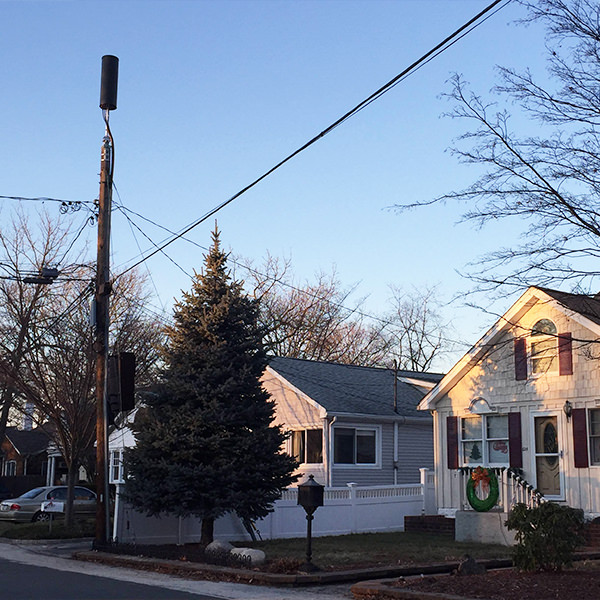
THE FACTS ON ZTA 19-07
Local impacts of “small” cell tower bill ZTA 19-07
Removes community participation
We should be a part of the decision-making process for changes that impact our neighborhoods, our homes, and our safety. However, ZTA 19-07 removes public notice and hearings, allowing a company to replace our street lights and utility poles with “small” cell towers 30 feet from our homes without any warning or input.
Allows high radiation levels close to homes
Hundreds of scientists are calling for caution with 5G infrastructure because of published research showing that cell towers emit harmful radiation levels—even though they are below current limits set by the Federal Communications Commission (FCC). FCC cell tower radiation limits have not been updated in 25 years, and are the subject of an active lawsuit EHT et al. v the FCC, which is awaiting a court ruling (See WTOP News Coverage).
Industry costs are subsidized by taxpayers
The ZTA shifts costs from companies to taxpayers as documented in Montgomery County’s fillings to the FCC. Review and enforcement costs are subsidized by resident taxpayers. (Read more)
Decreases home property values
Research shows that cell towers negatively impact property values by up to 20% because few buyers desire living next to a humming cell tower. Montgomery County acknowledges this in their legal filings, stating that, “the addition of facilities of this size diminish property values.” (See 2018 Ex Parte for 17-79)
Creates neighborhood blight
“Small” cell towers have equipment cabinets attached to the side of the expanded utility pole that can be as large as a refrigerator. There are no limits to the number of cabinets per pole, and there are no restrictions on how many wireless facilities may be clustered on a street. While current language requires a distance between the same company’s poles, it does not prevent multiple providers clustering on the same block. This could lead to neighborhoods littered with cell towers and wires, turning quiet communities into technology-ridden monstrosities.
Impacts to Tree Canopy
Adding cell tower poles up to 50 feet tall in neighborhoods will require the cutting of trees. ZTA 19-07 has no protections for the tree canopy nor accountability for tree trimming and root disturbance. That is why the Sierra Club of Washington DC called on the DC Council to protect the trees. We cannot afford to lose precious tree canopy.
Global impacts of our local “small” cell tower bill ZTA 19-07
Increased energy consumption
The Shift Project, a think tank of engineers and telecommunications experts, estimated in 2019 that digital communications were already responsible for 4% of global greenhouse gases, more than civil aviation — and that global digital energy demand is increasing by 9% every year, with dire consequences for the climate. A 2020 report entitled “Controlling the Carbon Impact of 5G” by the High Council for Climate found that 5G technology could add between 2.7 to 6.7 million [metric] tonnes of CO2 equivalents per year by 2030. Swedish energy expert Anders Andrae estimated that internet communications technologies could be responsible for 14% of global greenhouse gas emissions by 2040, undermining our efforts to combat climate change. An assessment of climate impacts of our County wide expansion of small cell wireless facilities should occur and the County should offset it.
Ensuring sustainable technology
Worldwide, numerous environmental groups are issuing position statements opposed to unfettered 5G deployment citing conflict minerals, worker hazards, and serious supply chain issues. 5G will mean hundreds of new cell tower installations in Montgomery County alone, not to mention thousands of new wireless devices. We must be clear-eyed about the global impacts and sourcing of this technology.
- Greenpeace France calls 5G a “digital pollution” that will increase carbon emissions, increase e-waste, strip the earth of natural resources and contribute to human tragedies on a global scale.
- The major Spanish environmental group, Ecologists in Action, issued a position on 5G calling for precaution.
- According to a report issued by Renee Cho at the Earth Institute of Columbia University, “Information technology is expected to be responsible for one-fifth of all global electricity consumption and by 2040. It could generate 14 percent of worldwide greenhouse gas emissions. If the entire system is not energy efficient, 5G will ultimately not be sustainable.”
Reports
RELATED TO THE ISSUE
MORE
Resources
Energy Use and Environment
- “5G base stations use a lot more energy than 4G base stations: MTN” by Fierce Wireless, April 3, 2020
- “Lean ICT: Towards Digital Sobriety: Report on the Environmental Impact of Information and Communication Technologies” by The Shift Project, February 2019
- “What Will 5G Mean for the Environment?” by Fierce Wireless, April 3, 2020
- “NAME” by Clair Curran of the Henry M. Jackson School of International Studies
- “Is Wireless Technology an Environmental Health Risk?” by Society of Environmental Journalists Journal
Safety
Investigate Europe’s Two-Part Investigation on 5G
Santa Clara Medical Association Magazine Articles
Quotes
“Considering that the Smart Communities’ prior filings show that the addition of facilities of this size diminishes property values, it is strange for the Commission to assume that approval can be granted in the regulatory blink of an eye.”
“If the new 5G environment, in fact, poses health risks, any prior rollout of 5G will have potentially injured citizens of Montgomery County and other municipalities, including sensitive populations like children, that cannot be undone. Such a result would be unconscionable.”
“These “small cell” installations not only can cause an aesthetic blight but can release levels of radiation that we don’t yet know conclusively the health impacts they can impose on
humans, especially developing bodies and minds of children. These small cell boxes could pop up anywhere: grocery stores, outside school, playgrounds, communal places, with no requirement to mitigate effects or understand potential environmental and health hazards”
“The District of Columbia must ensure that street trees are not aggressively pruned as DC moves toward small cell infrastructure. This technology requires a direct line of sight between small cells. That could require chopping off large portions of tree branches – which could kill some of the District’s largest and most majestic trees.”
“Wireless devices, antenna networks and data centers are consuming an ever- increasing portion of the global energy supply, based largely on coal…”
“If radiofrequency emissions from wireless handsets or equipment on our communications infrastructure are demonstrated to cause negative health effects, potential future claims could adversely affect our operations, costs, or revenues. We cannot guarantee that claims relating to radiofrequency emissions will not arise in the future or that the results of such studies will not be adverse to us. If a connection between radio frequency emissions and possible negative health effects were established, our operations, costs, or revenues may be materially and adversely affected. We currently do not maintain any significant insurance with respect to these matters.”
— Crown Castle (small cell infrastructure company) in their 2020 10-K Annual Report
“Behind each byte we have mining and metal processing, oil extraction and petrochemicals, manufacturing and intermediate transports, public works (to bury the cables) and power generation with coal and gas. As a result, the carbon footprint of the global digital system is already 4% of the global greenhouse gas emissions, and it’s energy consumption rises by 9% per year.”
— Jean-Marc Jancovici, President of The Shift Project, member of the French High Climate Council
